Depressed valuations present opportunity
Uzma is steeply discounted, with an O&G catalyst and satellite concession yet to be priced in.

Stock information
UZMA BERHAD
UZMA | 7250.KL
BUY
Target price: RM0.52
Last price: RM0.40
Market cap (RMm): RM243m
Shares out: 607m
52-week range: RM0.33 / RM0.56
3M ADV: RM0.7m
T12M returns: 18%
Disclaimer: By using this information, you acknowledge that you are solely responsible for evaluating the merits and risks of any investment decision and agree not to hold NewParadigm Research liable for any damages arising from such decisions.
Key takeaways
- Uzma’s valuations are steeply discounted, despite cyclical O&G catalyst and pending satellite concession from the government.
- O&G: Orderbook is already at RM3bn, roughly 2 years cover against current run rate. Hormuz disruption and high oil prices are catalyst for more wellhead services.
- Satellites: Uzma is getting virtually zero value from the market for securing the PSPJN concession (3+5years). We estimate an NPV of RM14m for this project, but offset by political risk from elections.
Share price performance
Investment fundamentals
| RMm (June FYE) | FY25A | FY26E | FY27E | FY28E |
|---|---|---|---|---|
| Revenue | 717 | 1,348 | 1,415 | 1,486 |
| Revenue Growth | 19% | 88% | 5% | 5% |
| EBITDA | 162 | 191 | 202 | 213 |
| EBITDA margin | 23% | 14% | 14% | 14% |
| Adj PATAMI | 55.3 | 56.4 | 57.7 | 65.6 |
| Adj NP margin | 8% | 4% | 4% | 4% |
| DPS (sen) | 2.0 | 2.0 | 2.1 | 2.4 |
| ROE | 8% | 8% | 8% | 8% |
| PER (x) | 4.3 | 4.3 | 4.2 | 3.7 |
| P/BV (x) | 0.4 | 0.3 | 0.3 | 0.3 |
| Yield | 5% | 5% | 5% | 6% |
Source: Company data, NewParadigm Research, July 2026
Building up the track record
- We think Uzma’s depressed valuations can be explained via a combination of the ESG discount on the O&G sector, a discount placed on the group’s diversification efforts, steep gearing, and occasional slippage in execution.
- But this should change. Uzma is looking poised to deliver ~RM56/58m in Adj NP for FY26/27E, which implies a PER of only 4.3/4.2x. This earnings outlook is underpinned by the RM4.1bn orderbook, primarily in the O&G segment. It also does not capture the PSPJN (National Remote Sensing Satellite Development Programme) satellite concession, that we conservatively estimate has a value of ~RM140m. Actual figures on the project have not yet been announced, but we anticipate it is likely to surprise on the upside against our conservative assumptions.
- The one risk to this project would be delays - potentially arising from political uncertainty if a general election is called prior to the finalisation of the concession agreement.
- The higher oil prices should also be a tailwind for the group’s wellhead services, especially for reactivation and enhancement of brownfield assets, given the elevated oil price environment.
- Uzma's solar venture is also poised to benefit from LSS6. We expect the group to bid for packages that include BESS, which if successful, would add meaningfully to the group's recurring income base.
Initiate with RM0.52 target price
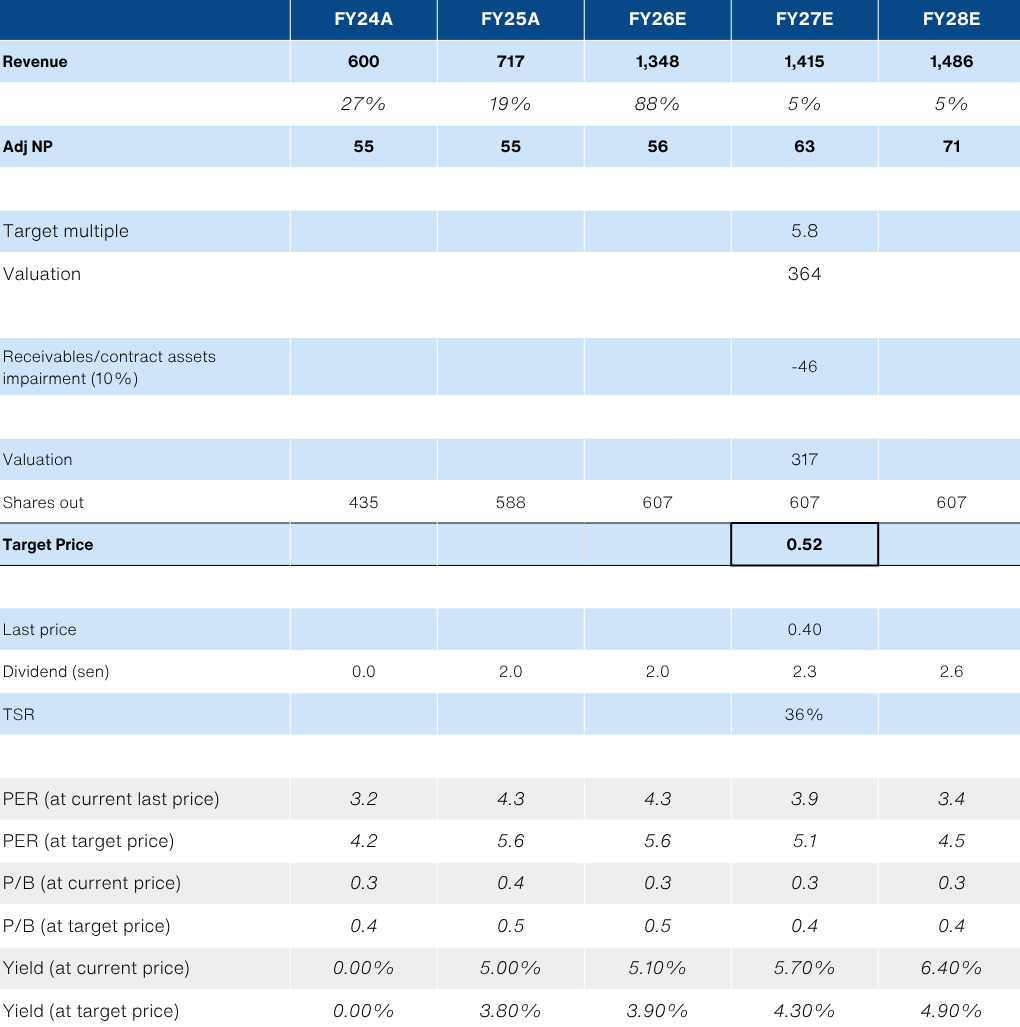
- On mean-reversion alone to 5.8x PER, Uzma should be valued at RM0.60. We conservatively trim the valuations to RM0.52 to include some buffer for the elevated working capital bloat.
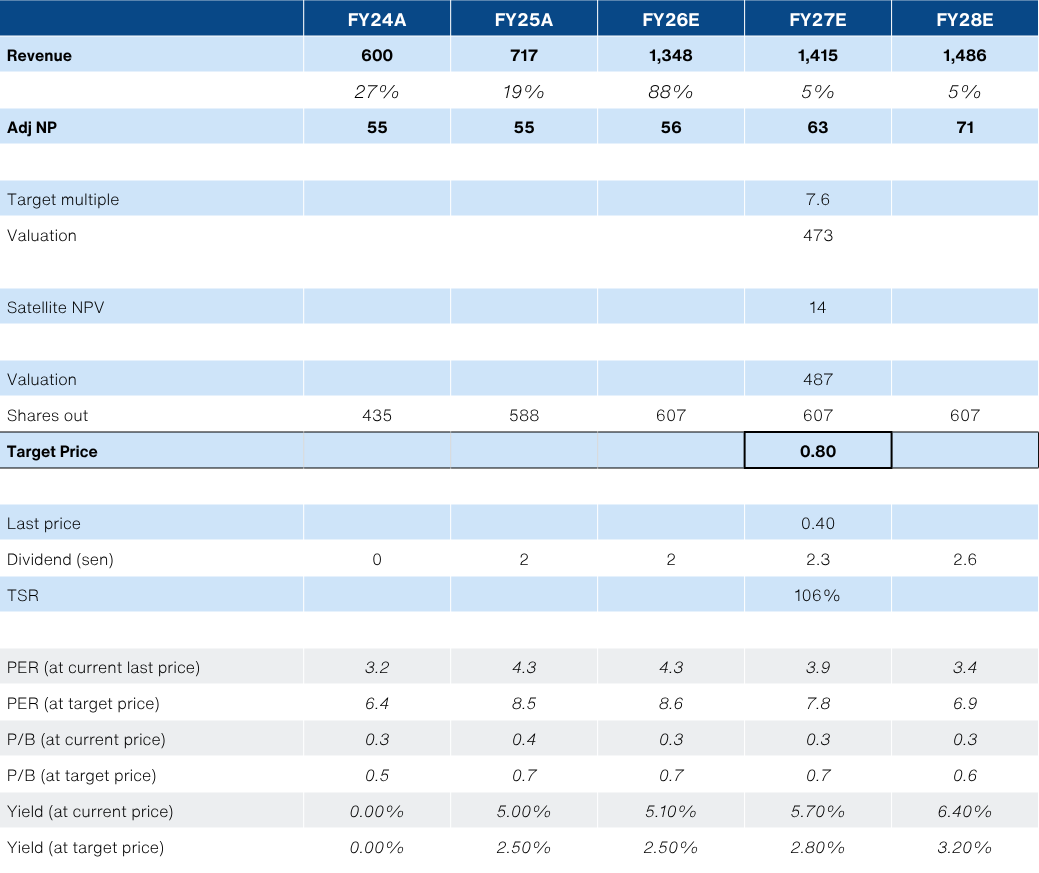
- However, in our bull case valuation, we include the RM14m NPV for the satellite concession as well as removing the working capital buffer. This gives us a bull case fair value of RM0.80.
- Initiate coverage with a Buy rating.
About the Company
Uzma is an O&G company that specialises in wellhead services - reactivating and boosting production in brownfield marginal assets. However, in recent years the company has been actively looking to diversify outside of O&G. The group has ventured into solar, gas trading, and satellite imaging. With the latest PSPJN Satellite Concession, Uzma’s new business foray should be a longer-term mainstay.
About the Stock
Uzma is a main-market listed stock that is controlled by founder Dato’ Kamarul Redzuan Muhamed (23.76%) and his wife, respectively the Managing Director and Executive Director. The company was founded in 2000 and listed in mid-2008.
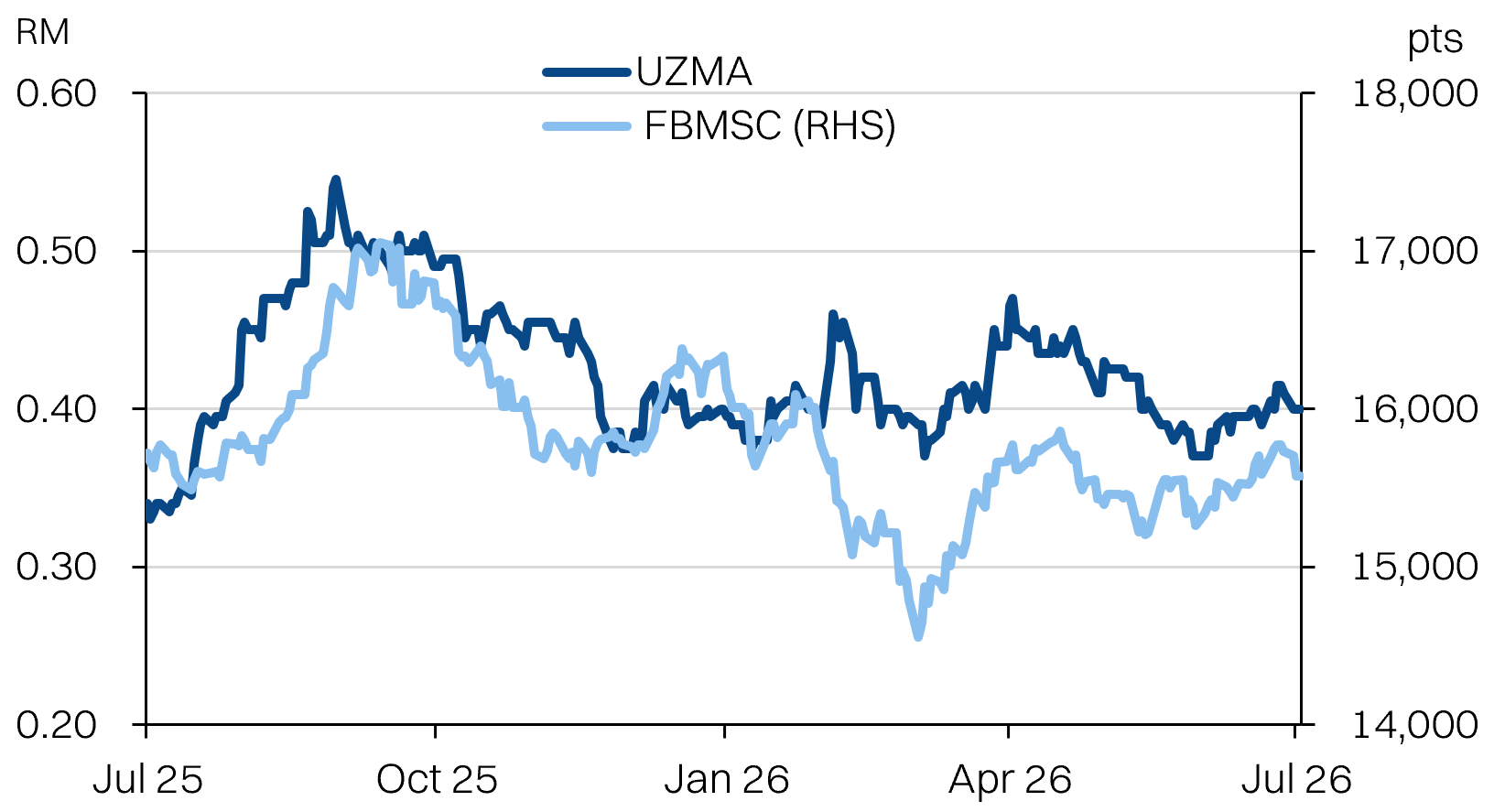
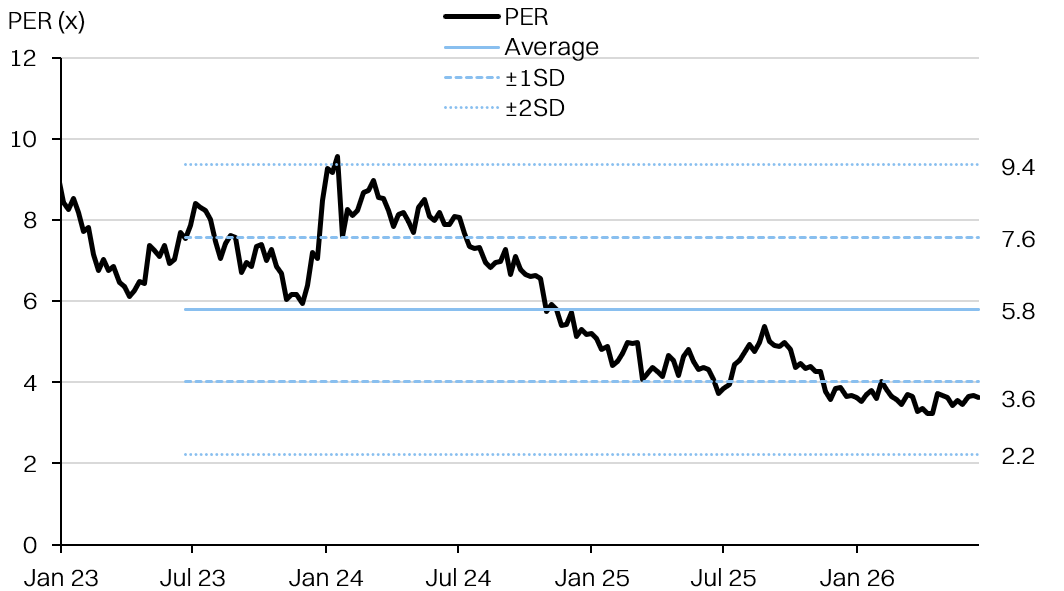
The stock has underperformed over the past year, falling from its previous PER range of 6-8x to only 3-4x. We pin this on disappointment around execution of projects, since orderbook for the group has actually been improving in addition to some of the key contract wins like PSPJN.
The stock is only modestly institutionalised. However, the only substantial institutional holder - Urusharta Jamaah - ceased to be a substantial holder in Dec 2025.
Investment Thesis
Uzma looks undervalued, at only 4.3x FY26E PER. Earnings have stabilised and gearing ratios are starting to improve - from the peak of 1.16x, down to 0.95x as of 3QFY26. Short term earnings visibility is also supported by a decent RM4.1bn orderbook.
Critically, we see a few catalysts that should help re-rate the stock. Firstly, the finalisation of the PSPJN concession agreement - which we estimate has an NPV of RM14m, conservatively, with room to surprise on the upside.
Additionally, the group’s O&G and solar segments should enjoy tailwinds from the elevated energy prices. The high oil prices are accelerating demand for wellhead services - to restart or enhance production. Meanwhile, the solar segment has a new set of tender opportunities from LSS6.
Key Risks
- Execution risk: Uzma has seen some slippage on projects in the past, including LSS4, based on news reports. However, these delays have not amounted to material penalties, based on disclosures.
- Receivables and contract assets are relatively high at RM462m (9MFY26), accounting for 23% of total assets. We’ve tried to account for this risk. By assuming a 10% discount (of the RM462m) against our valuation.
- Political risk: early elections could result in delays to the finalisation in the concession agreement. Assuming some vendor obligations are already locked-in (e.g. procurement, launch slot), there could be some margin compression to Uzma if costs cannot be passed on.
Geospatial Intelligence - Satellite imager
Uzma in 2025 saw the launch of UZMASAT-1 - a collaboration between Uzma and Satellogic. However, earnings contribution from the “Digitalisation and technology” segment has been underwhelming, leading to a muted market response to this venture. However, this has proven to be a springboard for Uzma to secure a first of its kind build-operate-transfer satellite concession with the government - PSPJN - that was awarded in May 2026.
Details are scarce on the project, since the concession agreement has not yet been finalised. We expect it should be completed within 3-6 months. The key risk, would be a snap election in the meantime, that could delay the decision. However, we see that as a good juncture to enter into the stock, as the worst-case expectations should be priced-in by then.
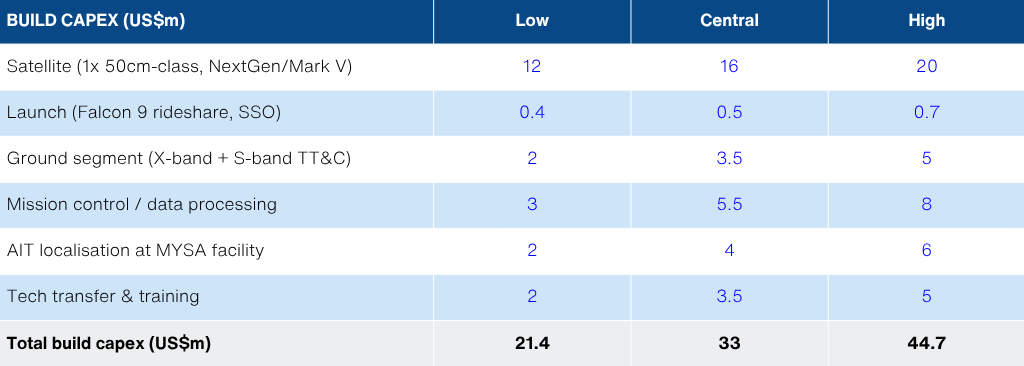
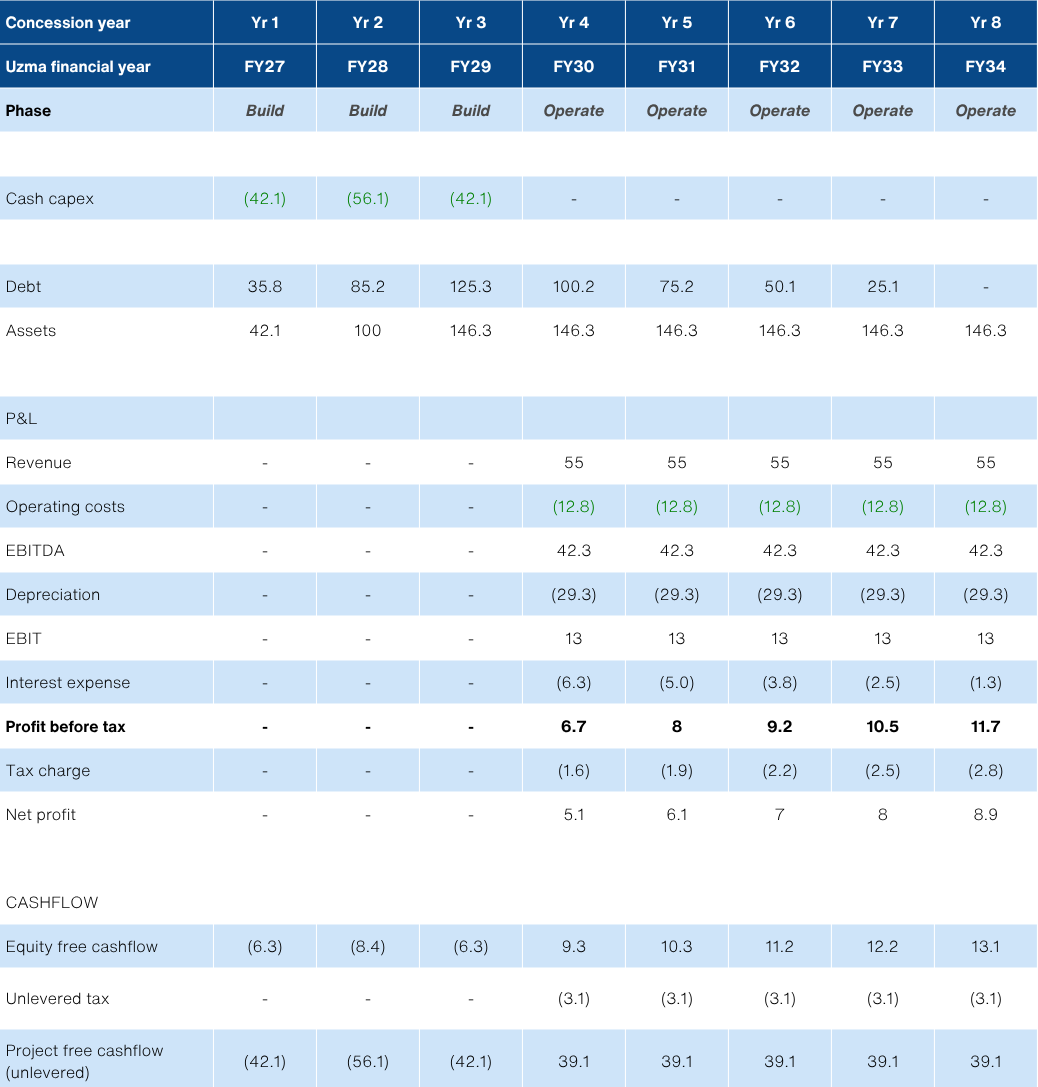
We estimate that the capex for the satellite would be ~RM140m, and stress that this is a high-level estimate since no official figures have been released. In turn, we estimate the NPV of the project would be about RM14m for Uzma. More importantly, it would solidify Uzma’s presence in this venture sector that has virtually no competition onshore, and pave the way to expand regionally.
Why satellites?
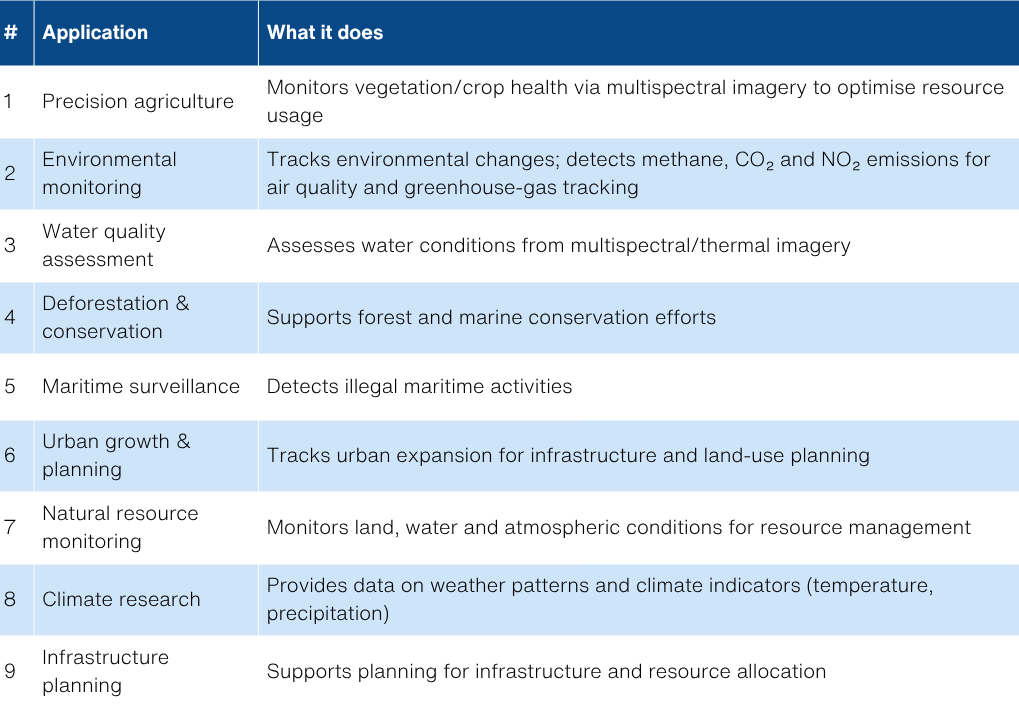
Details on the arrangement with Satellogic is limited. But we gather that Uzma has the rights to the satellite time, when it is over Malaysia - the company’s primary market. There are a wide number of applications for satellite imagery as well, including- precision agriculture, environmental monitoring and compliance, natural resource management, energy sector operations, and so on.
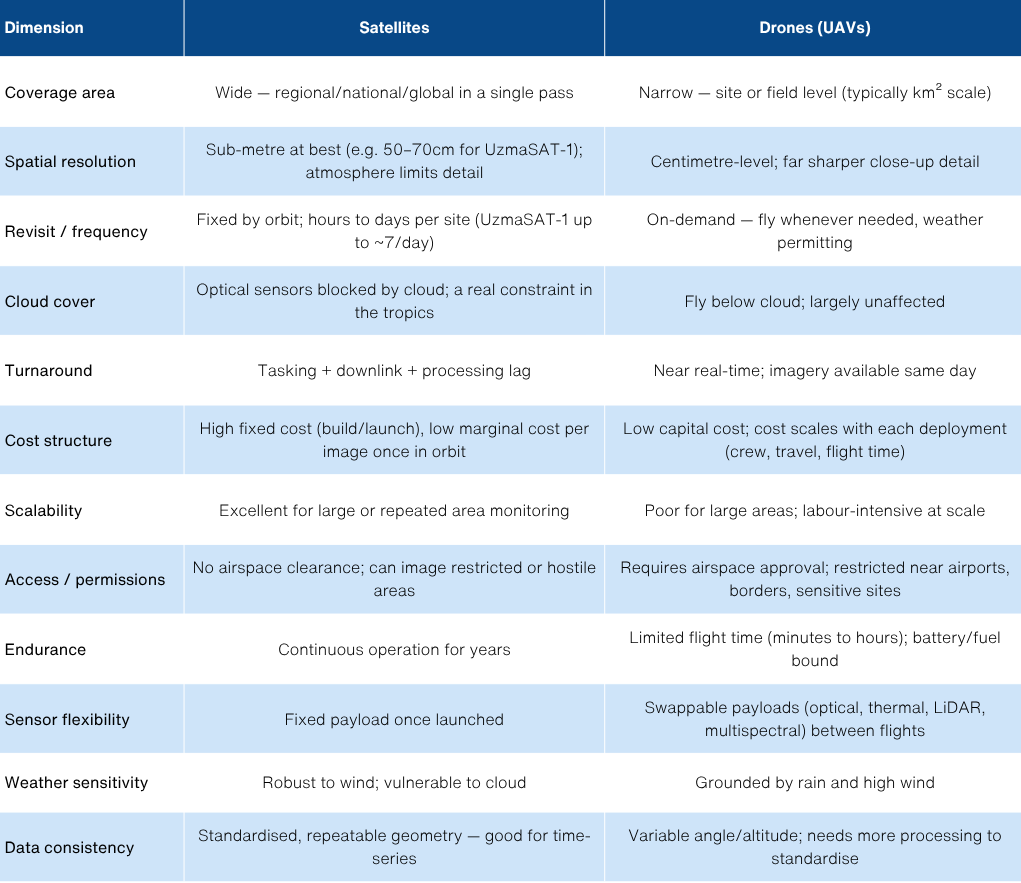
Fundamentally, one of the challenges of satellite imagery services is that it can be somewhat commoditised. Any satellite overhead can capture the images, with the differentiator typically being the resolution, spectral bands, and frequency of passes. There is a layer of value add on top of the imaging itself, which is processing the images into useful data. Another challenge to satellite imagery, is the low-cost and low-barrier of drones that offer much higher quality imaging. Drones however have limitations - smaller coverage areas, difficulty working in remote areas, and potential regulatory friction.
However, the key selling point of PSPJN is for a sovereign-controlled satellite. Some of the key risks around reliance on leasing assets controlled by another country is the risk of denial of access and lack of confidentiality. In short, national security considerations are driving the need to own the satellite.
UZMASAT-1 specifications
About Satellogic
Satellogic, Inc. (NASDAQ: SATL) is a vertically integrated Earth Observation (EO) and geospatial data company that designs, builds and operates its own constellation of high-resolution imaging satellites. Founded in 2010 (formerly Nettar Group) and headquartered in Davidson, North Carolina, the company went public in 2021 via a SPAC merger with Cantor Fitzgerald's CF Acquisition Corp. V. Its stated mission is to remap the entire surface of the Earth daily in sub-metre resolution at an affordable price point.
Satellogic's credibility rests primarily on its manufacturing track record and vertical integration. With more than a decade of experience in space, the company has a track record of delivering satellites to orbit and high-resolution data to customers. Its platform is built on the heritage of over 50 NewSat satellites, and — because it designs and manufactures in-house rather than buying spacecraft — it positions itself as able to deliver EO data at lower cost than peers. At its 2021 listing, the company claimed 17 commercial satellites in orbit, representing more capacity than the next four Earth Observation companies combined. It serves both commercial and government customers across multiple continents and has been expanding into defense and security applications, including a $30 million contract for AI-first constellation services announced in 2025.
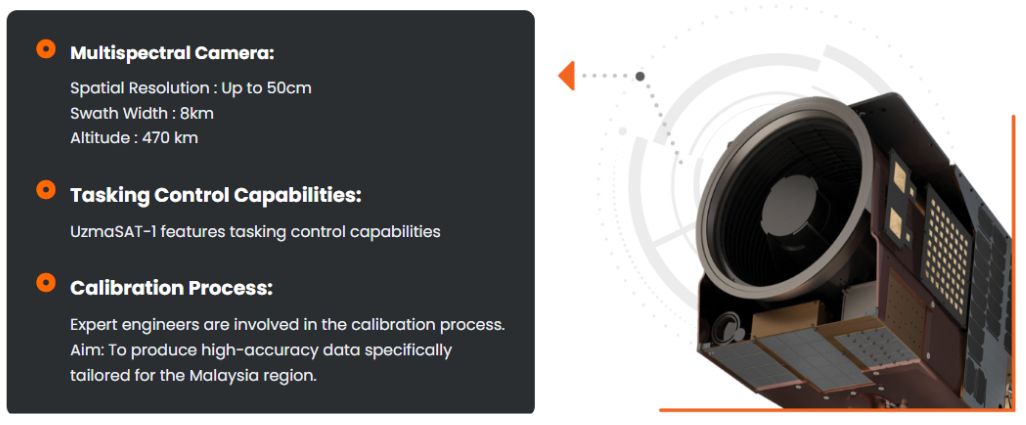
Satellogic is Uzma Berhad's technology partner on its space ambitions. The relationship began in December 2023 with a multi-year agreement to advance geospatial capabilities in Southeast Asia, delivered through Uzma's subsidiary Geospatial AI Sdn Bhd. This produced UzmaSAT-1, an EO satellite with up to 50cm resolution and tasking control, launched in early 2025. Building on this, in June 2025 Uzma — with Satellogic as its technology partner — was selected as the successful bidder to lead the Malaysian PSPJN for the government.
Applications for satellite imagery
Satellites vs Drones
The PSPJN Project: Background and History
The Program Pembangunan Satelit Penderiaan Jauh Negara (PSPJN), or National Remote Sensing Satellite Development Programme, was approved by the Malaysian Cabinet on 14 August 2019, with the Unity Government subsequently endorsing a revised programme roadmap. It falls under the Malaysian Space Agency (MYSA) within the Ministry of Science, Technology and Innovation (MOSTI), and replaces the terminated RazakSAT-2 programme — following that cancellation, all associated scope including a planned new ground station was discontinued, with MOSTI stating that the existing data-receiving stations at Temerloh (Pahang) and Banting (Selangor) are sufficient for national needs. The programme is a core component of the National Space Policy 2030 (Dasar Angkasa Negara 2030), which aims to establish Malaysia as a high-technology nation with sovereign capability in space.
Objectives
The programme's stated purpose is to build national remote-sensing capability and secure sovereign access to satellite data for strategic needs, while developing the local space industry through technology transfer and the involvement of Malaysian technical personnel. MOSTI has framed the public-private partnership (PPP) delivery model as a way to minimise government expenditure, reduce technology risk, and open satellite manufacturing, launch and service provision to local private-sector players. The end-use applications cited are agriculture, disaster management and environmental monitoring.
Terms and Structure
PSPJN is structured as an 8-year PPP concession, comprising three years to develop the satellite and five years operating it in low earth orbit. MOSTI has confirmed the PPP model is being used despite there being no specific allocation in the national budget — meaning the private concessionaire carries the upfront development funding and technology risk, with recovery over the operating phase. The government expects the satellite to enter operation around 2028, reflecting the three-year build following bidder selection. As of the February 2025 parliamentary session, the government described itself as in the negotiation phase with the selected bidder; a MOSTI site visit to MYSA's Banting complex in April 2026 noted PSPJN work spanning CubeSat development, ground station and testing facilities.
Uzma's Role
Uzma Berhad announced on 20 May 2025 that it was the successful bidder for PSPJN, describing it as an 8-year PPP concession (3 years develop, 5 years operate). The award builds on Uzma's earlier UzmaSAT-1 satellite (launched January 2025) and its Uzma Digital Earth (UzmaDE) analytics platform, and is delivered with Satellogic as technology partner. Uzma positions itself as a trusted local partner in Malaysia's sovereign space economy.
Estimated cost for the satellite
Upstream Oil & Gas Services
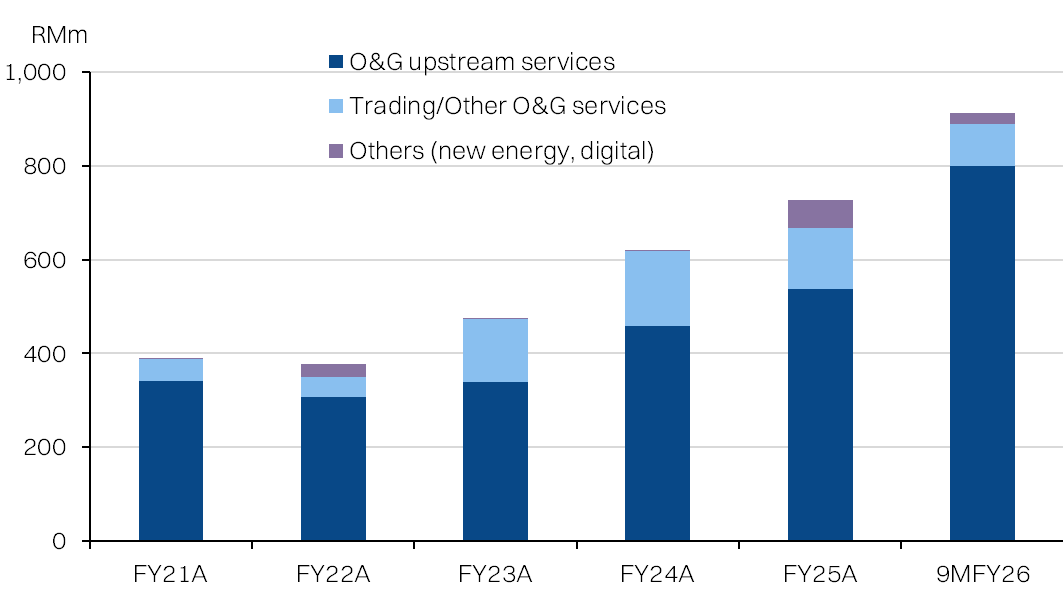
The O&G Services segment remains Uzma's core earnings engine, contributing approximately 84% of group revenue in 9MFY26 and historically around 70% of group earnings. The segment is supported by long-standing relationship with PETRONAS Carigali (PCSB) and remains the Group's main earnings contributor. We expect this to remain the Group's primary earnings contributor over the medium term.
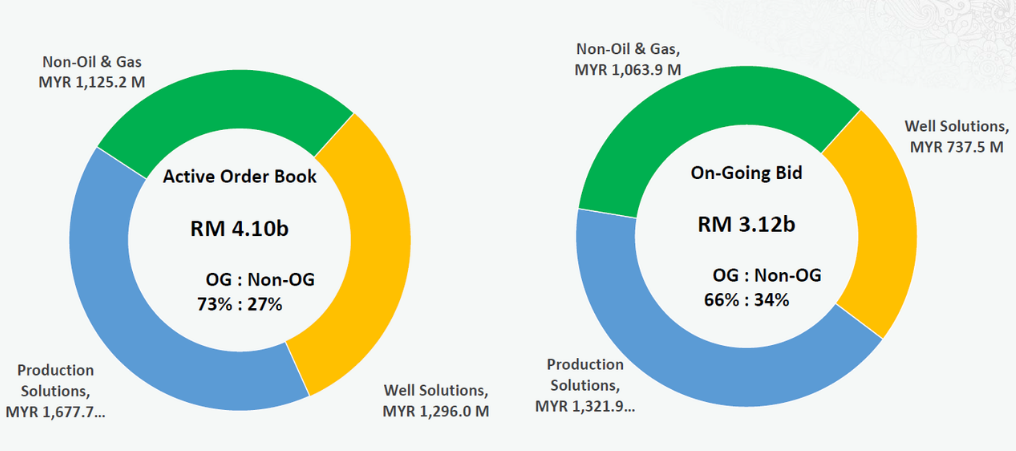
The segment comprises two divisions: Group Well Solution (GWS) and Group Production Solution (GPS). GWS generates project-based earnings from well intervention activities while GPS provides recurring income through long-term lease and operate contracts. As at March 2026, GPS accounted for 56% of the O&G order book compared with 44% for Well solution. Despite the broadly balanced order book, GPS has historically generated higher earnings.
Orderbook at RM3bn, roughly two years cover against current run rate
O&G services continues to anchor group revenue
Group Production Solutions (GPS)
GPS is Uzma's asset-based business, comprising Water Injection Facilities (WIF), Portable Water Injection Modules (PWIM), chemicals and artificial lift services. Water injection is the division's core business, accounting for more than half of the order book and serving as the main earnings driver.
We view water injection as the highest-quality business within GPS. Compared with conventional oilfield services, water injection projects generally generate higher gross margins due to their long-term lease-and-operate structure, while providing stable recurring income over contract periods that typically range from five to ten years.
Daily rates are also structurally higher than pure-service contracts, as the scope extends beyond injection equipment to include accommodation, utilities and platform facilities. Among the two water injection solutions, Water Injection Facilities (WIF) command higher daily rates than Portable Water Injection Modules (PWIM) due to their broader scope. The more comprehensive the facility, the higher the contracted daily rate.
Water injection projects require significant upfront capital investment, typically financed through borrowings. While this results in higher depreciation and financing costs during the early years, these costs decline over the life of the contract, supporting stronger profitability as assets mature.
The outlook for GPS is supported by PETRONAS' target to grow domestic production from 1.7 to 2 MMboe/day, which requires sustained investment in production maintenance and enhancement directly benefiting water injection demand. We also expect higher production activity to drive greater demand for oilfield chemicals, including corrosion inhibitors, scale inhibitors and flow assurance chemicals, which should benefit Uzma's MECAS subsidiary.
Group Well Solutions (GWS)
GWS is Uzma's project-based oilfield services business, covering coiled tubing (CTU), hydraulic workover (HWU), wireline, cementing and plug-and-abandonment (P&A) services. Earnings are primarily driven by customers' drilling and well intervention activities.
Coiled tubing remains the division's largest service line and is expected to benefit from increasing well intervention activities as Malaysia's offshore fields mature. We expect GWS to deliver a stronger performance in 4QFY26 as upstream activity typically peaks during the middle of the year before slowing towards year-end due to the monsoon season.
Beyond Malaysia, Uzma is pursuing opportunities in Vietnam and Myanmar for its GWS business. Myanmar's opposite monsoon season could improve equipment utilisation throughout the year, while Indonesia remains an important market to further expand its coiled tubing services.
4QFY26 earnings could be cleaner as monsoon passes and water injection resumes
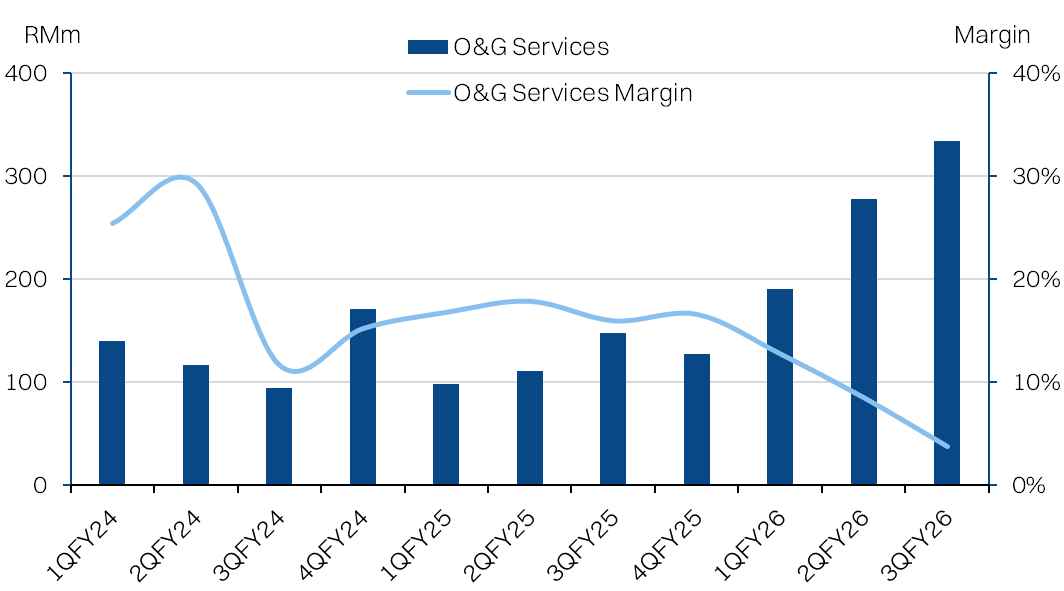
On a 9M basis, O&G services revenue reached RM765.9m, already surpassing the full year FY25 figure of RM538.5m by 42% with one quarter still to go. However, margins contracted noticeably, driven by the inclusion of seismic work, which carries thinner margins and has weighed on blended segment profitability.
3QFY26 revenue at record high, margin compressed by seismic contract
We expect GPS to remain the primary earnings driver within the O&G segment, supported by its recurring lease-and-operate contracts and sizeable order book. As at 3QFY26, GPS accounted for RM1.7bn, or approximately 41% of the Group's RM4.1bn active order book, while also representing the largest share of the RM3.1bn ongoing bid book at RM1.3bn. This provides good earnings visibility over the medium term, underpinned by long-term water injection contracts.
In the near term, margins should improve in 4QFY26 as water injection operations resume normal utilisation following the monsoon season. Beyond FY26, continued execution of the existing order book is likely to remain the key driver of GPS earnings, while GWS should continue to benefit from ongoing drilling and well intervention activities, albeit with a more project-based earnings profile.
Most recently, PCSB awarded Uzma Engineering an eight-year contract for the Bayan Redevelopment Phase 3 project, effective 27 March 2026. The scope covers the design, engineering, procurement, construction and transportation of one Portable Water Injection Module (PWIM) during the first year, followed by seven years of operations and maintenance, with an option to extend for a further two years.
Although the contract value was not disclosed, the project is expected to commence operations around mid-2027. As the project involves a PWIM rather than a full Water Injection Facility (WIF), its earnings contribution is likely to be relatively modest during the initial years.
Overall, we believe the O&G segment will continue to underpin FY26–FY27 earnings, driven primarily by GPS through the execution of its recurring water injection order book and improving utilisation, while GWS provides incremental growth through ongoing project execution and overseas expansion.
New Energy
Uzma entered the renewable energy sector in March 2021 through the acquisition of a 49% stake in Suria Infiniti Sdn Bhd and a 100% stake in Mahendran Surya Innovations Sdn Bhd, initially establishing itself as a solar EPCC contractor. Shortly after, the Group secured a 50MWac large-scale solar (LSS4) project in Kuala Muda, Kedah, marking its entry into renewable asset ownership under a 25-year power purchase agreement (PPA) with TNB.
Uzma's share price re-rated following LSS4 award
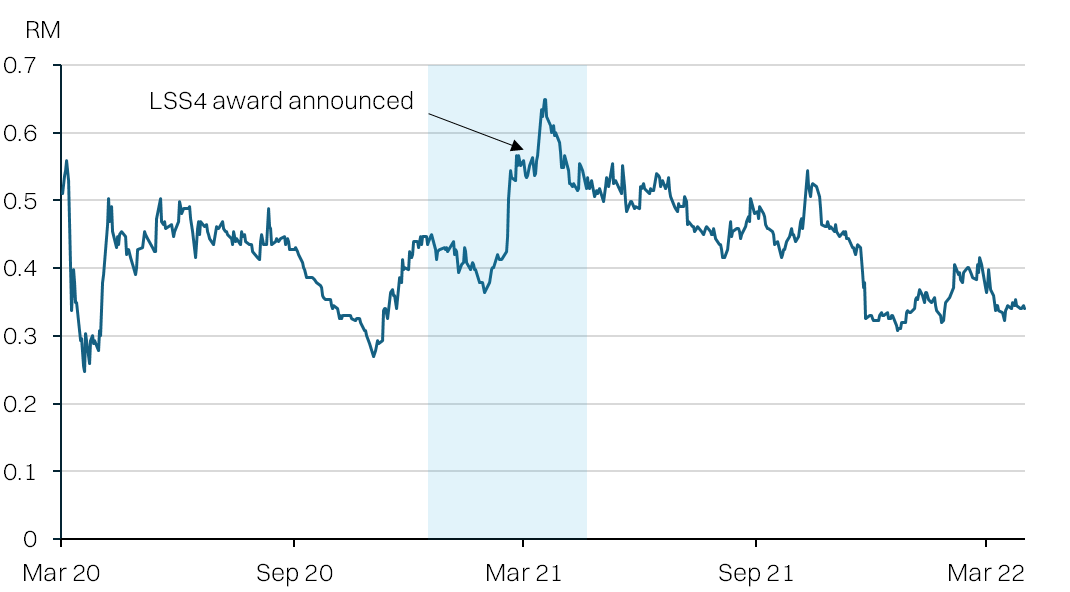
The announcement of the LSS4 winners on 12 March 2021 marked a key milestone in Uzma's renewable energy strategy. Notably, Uzma's share price had already begun rising ahead of the official announcement, suggesting the market had begun pricing in the award. Following the announcement on 12 March 2021, the share price extended its gains to a peak of RM0.649 on 18 March 2021, representing a rally of approximately 43%.
Since achieving commercial operation in September 2024, LSS4 has become the Group's first operating renewable asset, providing recurring income from electricity generation. In 1QFY26, LSS4 contributed RM4.6m of revenue, implying a recurring annual revenue base of approximately RM18m from electricity generation.
Together with ongoing CGPP and EPCC activities, the New Energy segment generated RM23.9m of revenue and RM4.4m of operating profit in 9MFY26, turning profitable on an operating basis. We project full year FY26 New Energy revenue at approximately RM34m, underpinned by LSS4 electricity generation at approximately RM4.6m per quarter and contributions from CGPP and other solar related projects.
LSS6 in sight, but BESS execution remains unproven
Looking ahead, Uzma has indicated it will participate in the LSS6 bidding round, launched in July 2026. LSS6 calls for 2.65 GW of solar and 1.25 GW of BESS across three packages:
Project details of LSS6
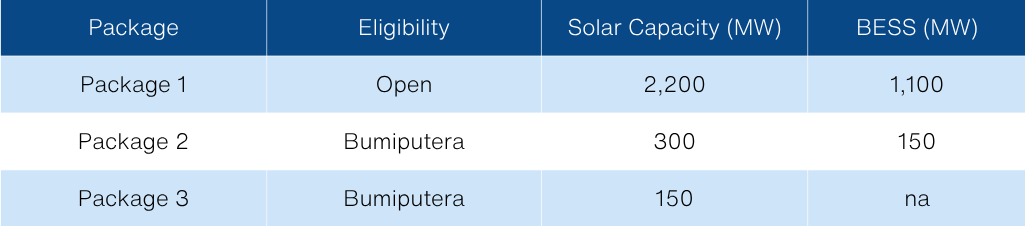
We expect Uzma to bid for packages that include BESS. On the cost side, falling input prices provide some support to project economics. Silver prices have declined approximately 26% from early 2026 levels, while polysilicon prices are down approximately 21% from their peak during the conflict period. Lower panel costs help offset the higher capital outlay from BESS.
That said, BESS execution remains unproven for Uzma. While the group has a track record in solar PV construction, battery storage introduces meaningfully greater technical complexity. We have not factored any LSS6 contribution into our forecasts at this stage.
The capital question adds a further layer of caution. Renewable asset ownership is inherently more capital intensive than EPCC activities, and any successful LSS6 bid would likely require additional borrowings putting upward pressure on gearing and finance costs before new projects begin contributing to earnings.
Valuation
Uzma appears to be trading at highly depressed valuations - only 3.9x FY27E. Uzma’s 3-year historic average PER is 5.8x (1yr blended forward). We think part of the reason for the depressed valuations could be the bloated balance sheet, with net gearing of >100%. In addition, the recent jump in revenues have come with elevated working capital requirements but lower margins.
To account for some of the balance sheet risk, we have included a 10% impairment risk in our valuations against receivables and contract assets (9MFY26: RM462m or 23% of total assets).
We applied a target PER multiple of 5.8x, in-line with the 3yr historic average. After stripping out the impairment risk, our TP is RM0.52, which implies an upside of 36% against the last close of 40 sen.
Valuation table
Historic PER: Uzma is trading at -1SD to historic average.
Bull case: Pricing in the satellite concession
Details are scarce on the PSPJN Satellite Concession. However, we estimate that the capex for the project could be ~RM140m. We estimate the DCF to equity is ~RM14m, on conservative project economics, including zero residual value. Notably, the earnings from the concession fall outside our 3-year forecast period. However, we anticipate that on final signing of the concession agreement, UZMA could re-rate to +1SD vs its historic range, as market perceives this as both validation of the business model and opens the door to subsequent tenders.
Bull case valuation
Cash flow projection for PSPJN
Selected financials
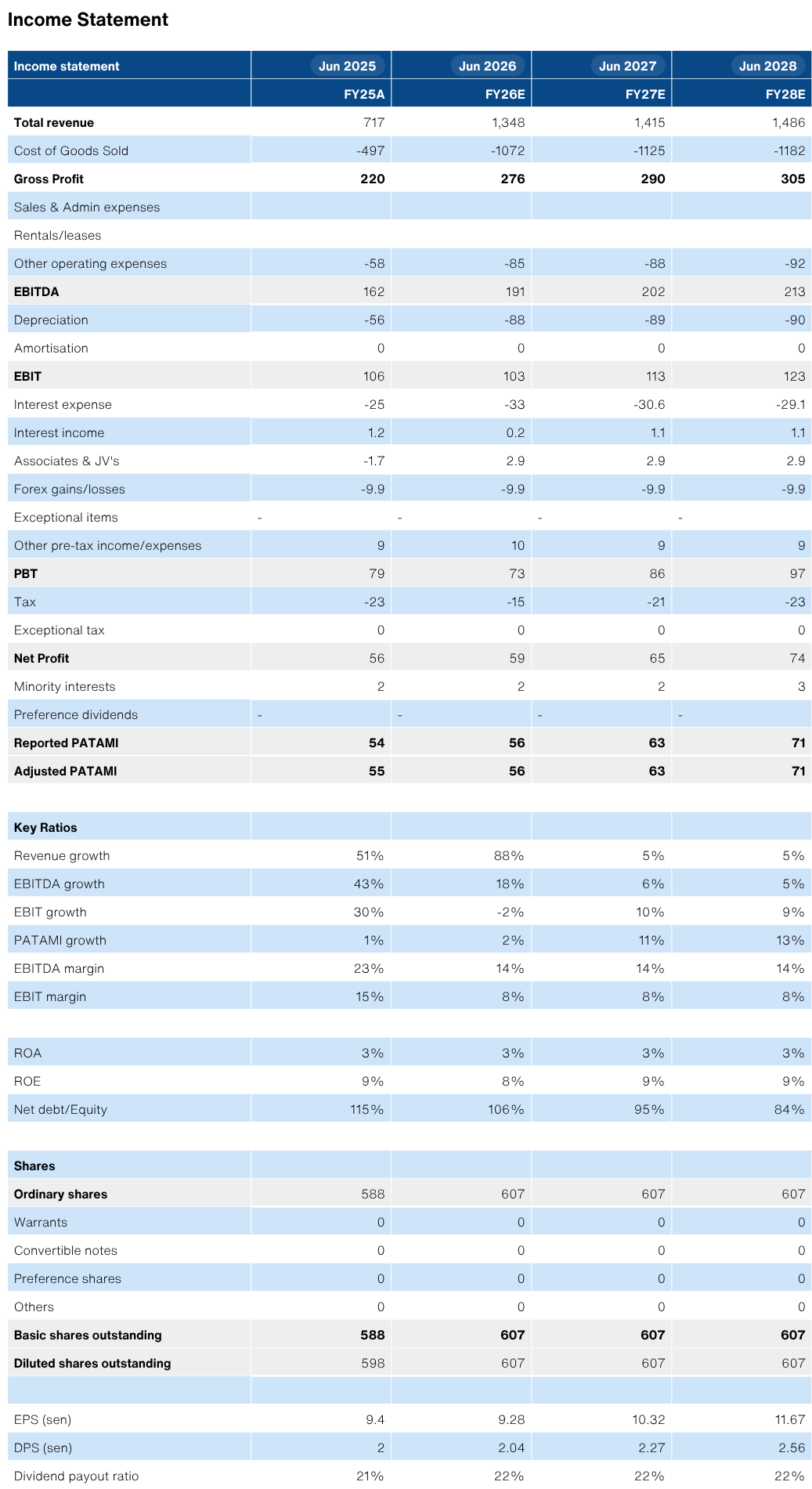
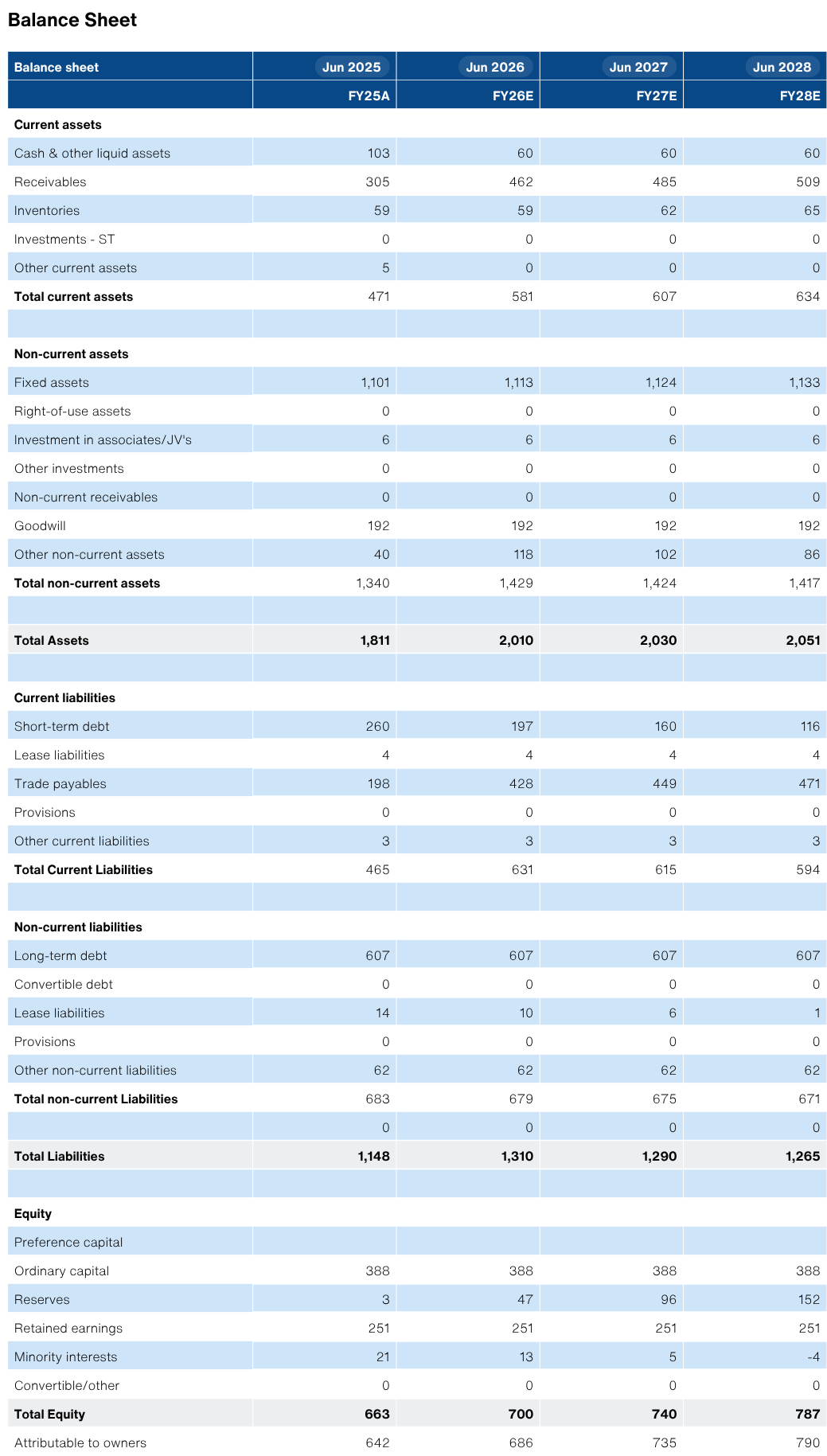
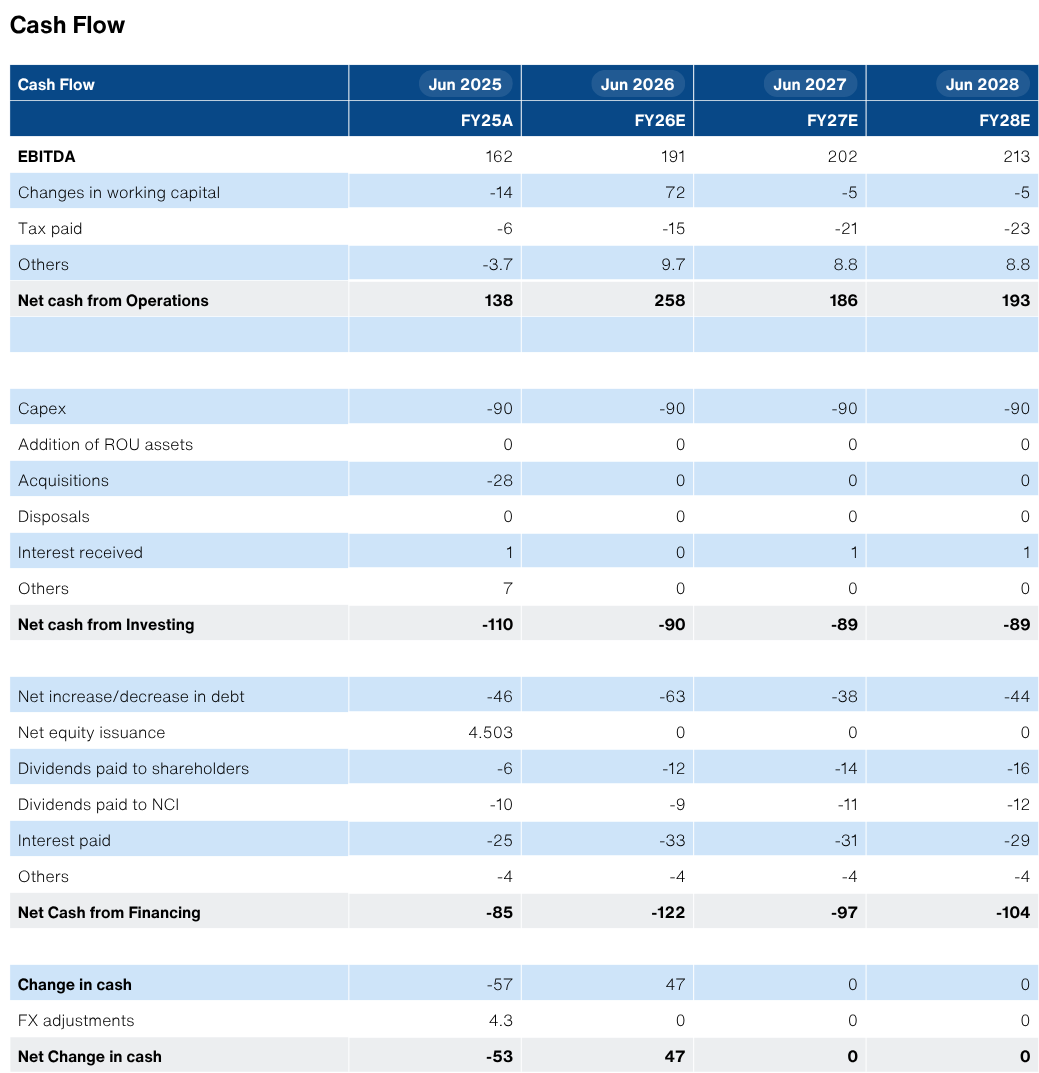
Source: Company Data, Bloomberg, NewParadigm Research, July 2026